Made in USA?
← Swipe →
































Meanwhile, it's like this; when we started in business we discovered the hobby wholesalers wanted to order 1000pcs, but spread across the line. With 50 servos, this meant they wanted to buy 10-20pcs of some servos, 50pcs of others. And at the same time, they needed a 60% margin.
Seems like too much margin? Not really because that worked out to ~25% for them (about what they need for what they do) and ~40% for the hobby dealer. Too big a cut for a hobby shop? Again, not really, at least not in a world where rent for a store in a strip mall is $6000/month! Proof?
Ever seen a hobby shop owner's wife driving a 2yo Cadillac or Mercedes? Answer isn't just no, but Hell no! So putting figures to it, they wanted to pay us $44 for what the end user pays $100. This so they could sell it for about $57-60 to the hobby shop who in turn sells to the customer for $100.
Honestly? This didn't math out for us because it put us head-to-head with all the Asian vendors like Hitec who rely on that exact same business model. And in further honesty, we couldn't hope to match the prices of east Asian producers no matter what, or put another way, using that business model meant being more expensive.
So we approached it differently. What if instead, we ditched that business model? And what if we also spent whatever it costs to make genuinely better servos. And 'then', after pricing the servo where we needed it to be for us, then sell it to everybody in any quantities? Meant being wholesale to everyone!
Anyway, this fits right in with our wheelhouse, e.g. we 'like' going to the Nth degree on stuff. Think machined finned alloy cases instead of die extrusions. Or using 13 o-rings for sealing, MIL-STDS nobody else does, insert molding brass hardpoints within the polymer case, and speccing all-stainless steel gear trains . . . e.g no shortcuts whatsoever! Well, modelers may be cheap but they're not stupid and sensing a bargain they swarmed to buy. And this formula not only worked right out of the gate, now approaching 15 years later we're still hitting on all cylinders!
Recapping, we're wholesale to everyone qty 1 to 10,000. Presently, we sell more than we can make, which is why we run out sometimes. Presently running a batch of 6000pcs of our DS630BLHV for a contractor for some vehicle. In fact, it's going to be a near thing we run out of stock before we can make more for us!
Point being, if someone on your side thinks to ask, our offering a price break based on volume is pointless whether it's 10s, 100s, or 1000s. Another thing; we're set up to deliver hobbyists quantities out of our run rate stock (the 500pcs we produce for our own inventory every 3-4 months). But supplying more than hobbyist quantities, say you want 50 or 500pcs will results in a our giving you an RTS date of 90-days post payment (RTS is ready to ship). Also, we don't use a shopping cart for that. Send us your PO and we'll respond with a purchase invoice. Note; neither do we deal with how long something takes to arrive as that's not our gig, so how long it takes after it leaves here is on you, so plan accordingly. And while we're on the subject, it's 100% payment in advance and we won't so much as put you on our production schedule before we're paid.
Regarding components sources, we're asked this often. In fact, the usual question is . . . are these made in USA. Answer is, nope – and – if that's what you're seeking, it doesn't exist. Anyone claims different is full of shit. And yes, I suppose I could lie about it, but that's not our style. So because your question is too important to skip the important details, I hope you find enough answers in what follows.
Country of Origin
Deceptively simple, servos are actually made up of various components, to include;
- case – either all aluminum, or hybrid (aluminum and polymer)
- motor – three types
- potentiometer
- printed circuit board (aka PCB) – if you're genuinely curious, review this article, it's fun
- components (think resistors, diodes, power transistors, controller, etc.)
- gear train
- bearings
- wire lead
- machine bolts
- o–rings
- potting compound
- rubber mounting grommets
- brass eyelets
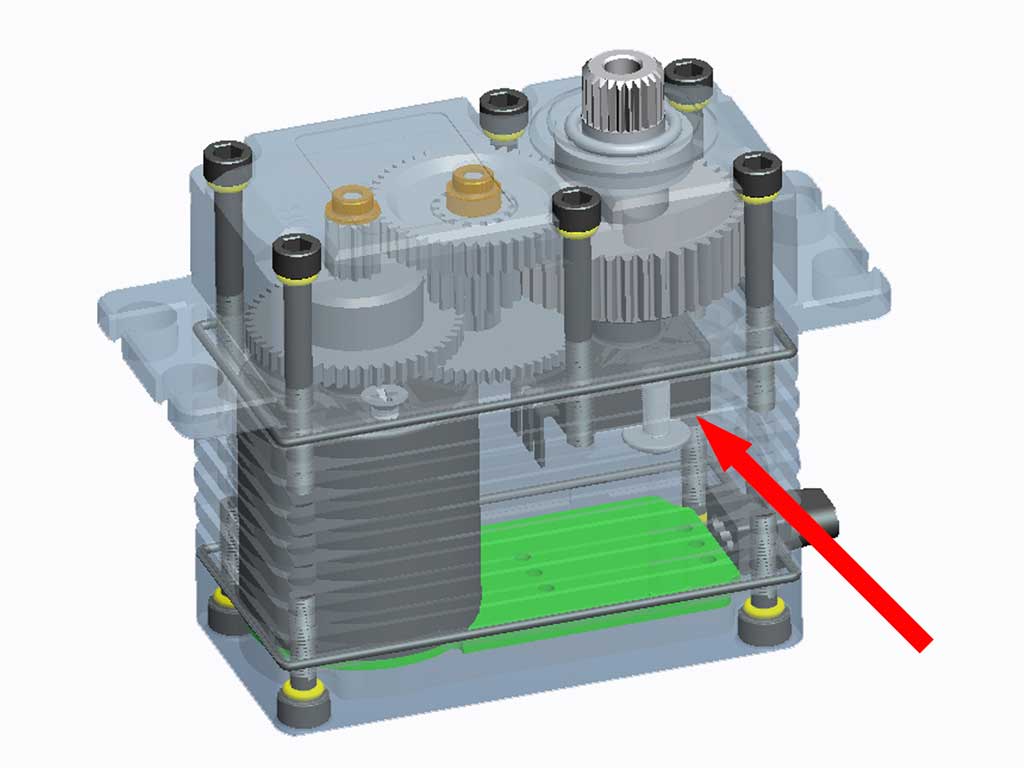
Big stuff
In common with all our servos, the alloy components for the cases are domestic (us). The injection molded parts are done for us (with our molds) in South Korea by Hyundai (yes, 'that' Hyundai who have their fingers in a lot of pies, e.g. refrigerators, ocean going vessels, etc.). The actual motors are of Japanese origin. Ditto the potentiometers, which are also out of Japan. Leaves the PCBs.
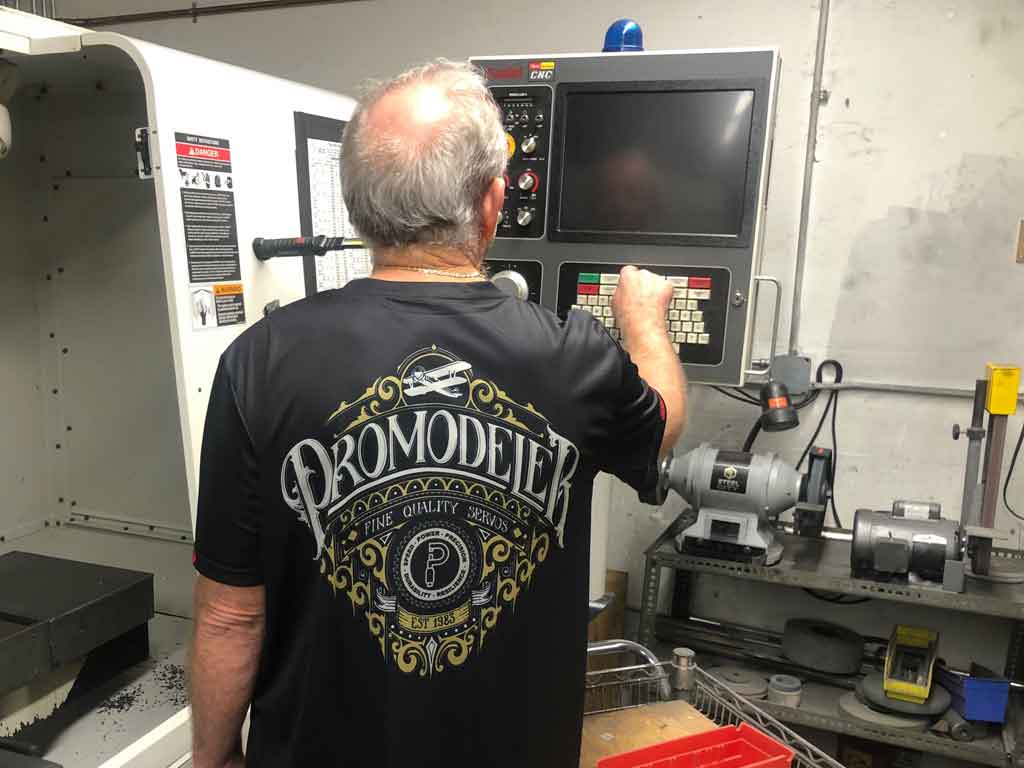
Printed Circuit Boards
As regards the PCB (printed circuit board), these are presently done for us in the Philippines, but the country of origin varies depending on who has spare capacity when we need a run. Let me delve deeper for a bit more nuance because every detail matters.
Reason PCBs are not always done in the same country is simple; all these guys (circuit board makers) are trolling for orders in the millions (or at least hundreds of thousands) and in all honesty, we're nobbut small fry representing a few thousand boards at a time.
Remember, unlike an iPhone with three variations resulting in 50M boards, we produce 50 different servos but each PCB is different. So we're not just low volume, but we're a pain in the ass to produce for because each PCB is different!
Incidentally, this is what we're talking about. A board (what we call the whole thing). The whole board is something a lot like a sheet of stamps, or Saltine crackers, with perforations allowing us to crack them into individual pieces (look closely at the edge of a stamp or cracker and you'll see the remaining nubs which held them together).
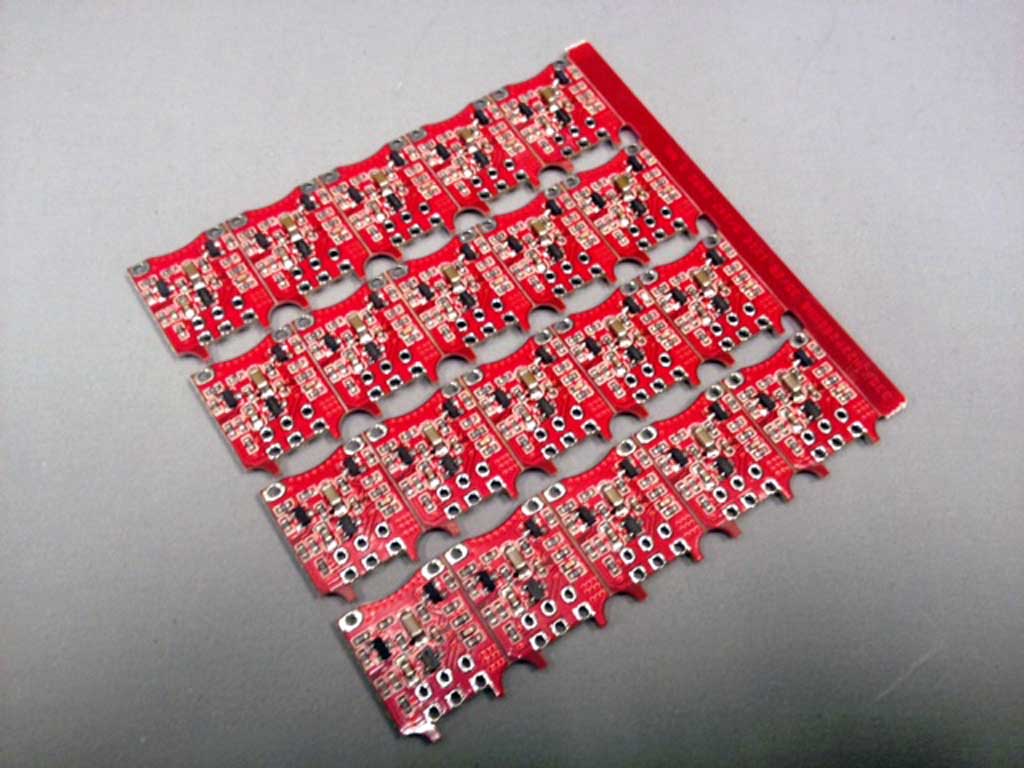
Major point being, these outfits they take us on (but reluctantly, almost like they're doing us a favor). This, I suspect, principally in the hopes we'll develop into larger orders. And note, we can make our own PCBs, just not in commercial volume. Talking strictly at prototype quantities only.
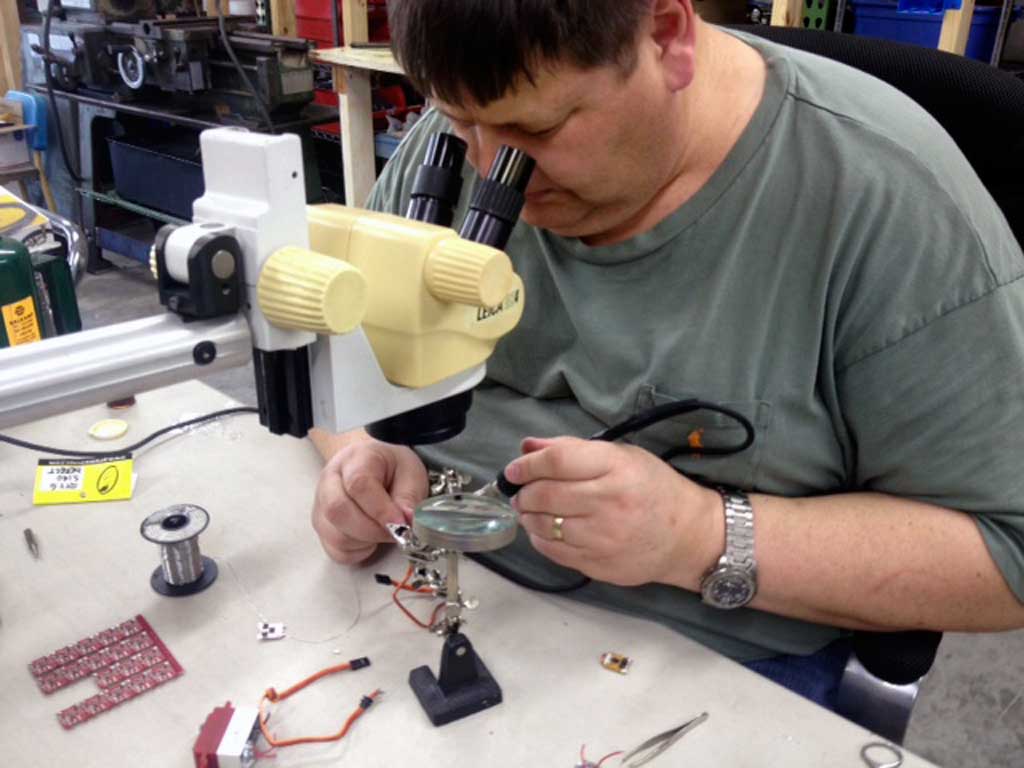
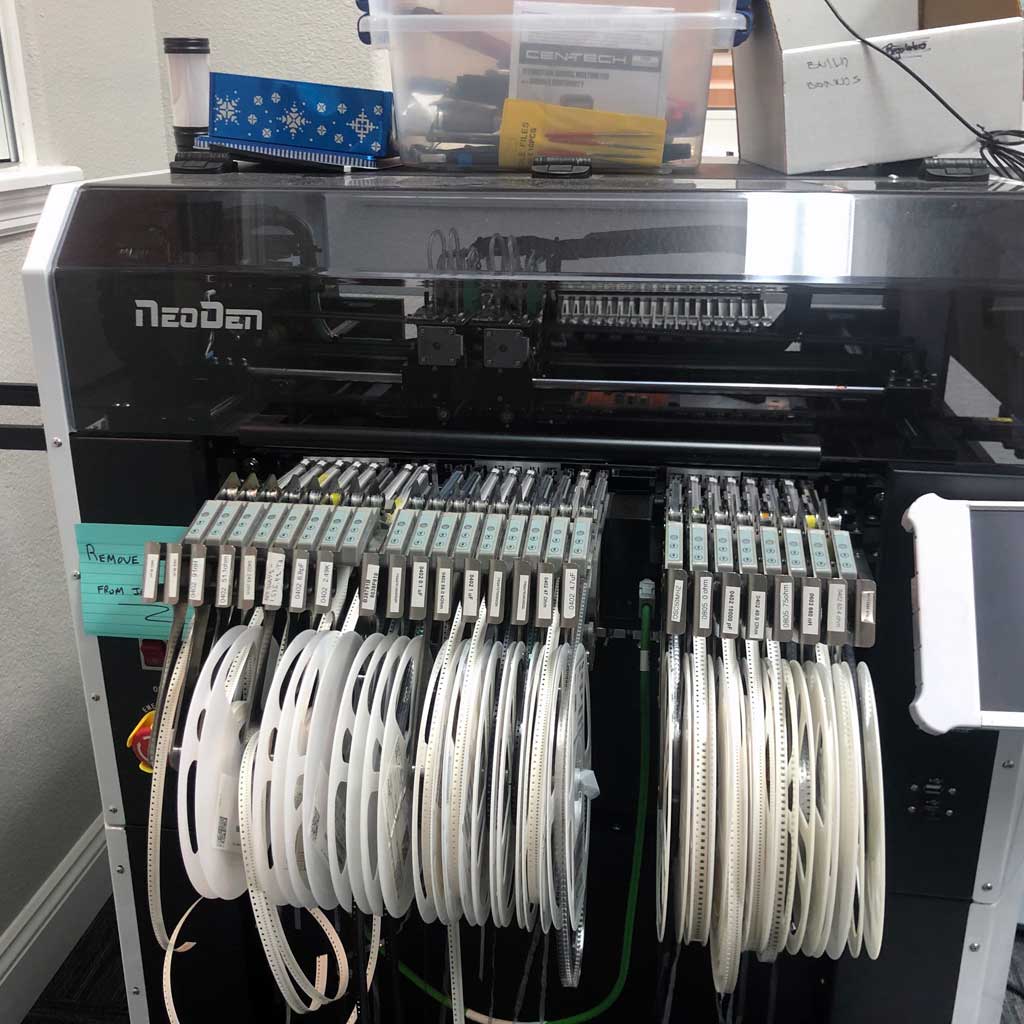
And before you ask, the price of our servos probably triples, maybe quadruples if we tried doing boards internally because of how slow it would be. For example, not only is a prototype machine too small and slow compared to a production machine, but a factory has hundreds of them. Like we're talking literally rows and rows of these pick–and–place machines!
Saying even a small batch of perhaps 500 servos would take many months. Sure our machine does the same thing but it's made for onesie–twosie jobs versus production, e .g. prototyping.
Summary of PCBs
Ultimately, what this means – in the real world – is sometimes the PCBs get made by someone else other than Philippines (who is presently doing them). Point being, if they're too bucy to take us on, we may turn instead to someone in Vietnam, Japan, Taiwan, Israel, China, Malaysia, Czech Republic, South Korea, or even USA (but unlikely because the price is almost always 3X too high).
As an aside, we've had customers say they don't care if the PCBs cost 3X as much. problem is, we're competing against other companies and if our product price is totally out of whack then sure, they say they don't care but I assure you, everybody else does. So we are to a great extent boxed in by our competitors.
Why? Simple, it's because the PCBs are an automated low margin component and nobody is going out of their way to court our business because we don't represent serious money. Again, this is because – at heart – we (ProModeler) just don't represent enough volume to make us an attractive customer.
As regards the big guys, servos produced by the likes Hitec, Futaba, Spektrum? Honestly, they are akin to the 800lb gorilla in the business. So big I'd bet a milkshake they have producers calling on them versus having to beg like we're almost forced to do. We actually have to call around to inquire who has spare capacity at the moment. Anyway, this is part of why their servos generally costs less than ours. But it is what it is, I'm not crying, I'm explaining.
Point being, unless and until we get bigger, then know this; whomever does PCBs for us, really only does it because they have spare capacity, and are sufficiently desperate for work to take us on. They do it despite knowing we're small fry unlikely to become the next Sony Blu-Ray representing a gazillion boards, because they need the works. Nobody is doing anybody favors, capisce? So the bottom line for any of these circuit board makers (in terms of signal–to–noise), our itty–bitty orders are simply within the noise of a monthly sales report.
Design
Next, to the question regarding designing them in USA? Well yes, but let me explain a little more. Every component is designed in house, but not to a manufacturing level of detail.
For example, we buy potentiometers, we don't make them. So in this next image, eyeball the pot (top right corner of the right hand monitor) and specifically, note it's an entire component within the design program. Means they send me the step file for the potentiometer. I subsequently incorporate it into our servo. But in no wise do we design the potentiometer. They do because it's their product.
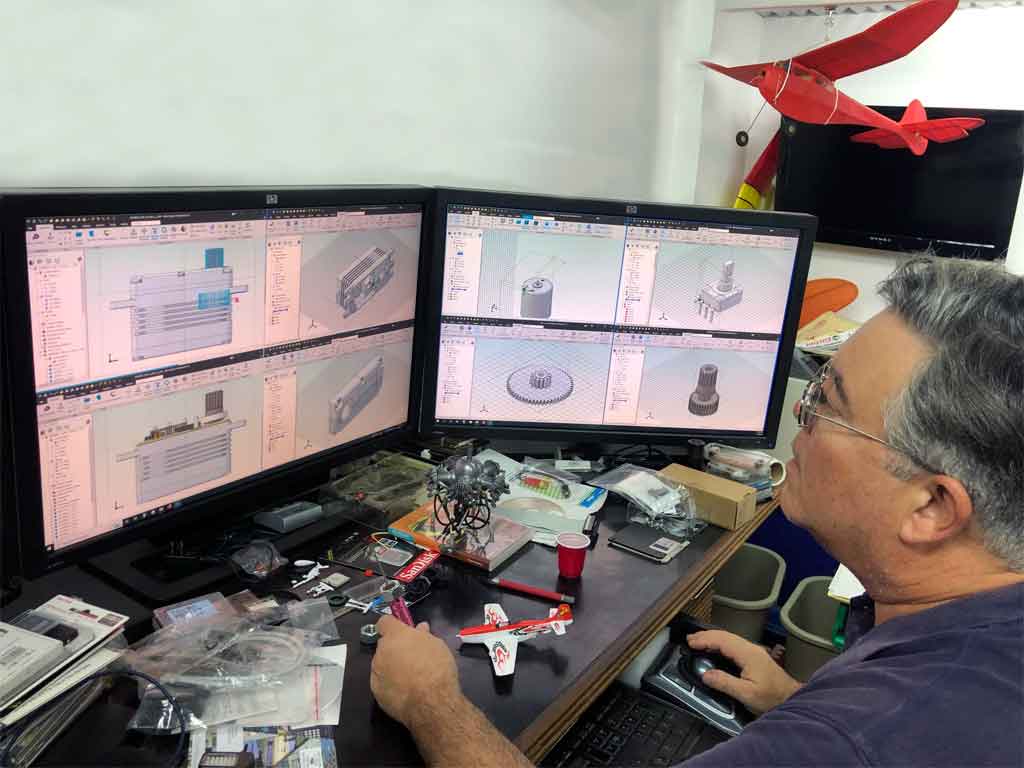
Ditto the motor, as well as the individual components like diodes, logic board, etc. So yes, technically I design the servo – but – a lot of components are supplied to us as step files for integration into our servos. So this is why I qualify things by saying yes . . . but.
Another example are gears; our principal supplier (Taiwanese) has an extensive catalog. As does our backup supplier (also in Taiwan). And not just individual gears but of complete gear trains! In fact, it wouldn't surprise me other servos are using gears made by these same folks because unlike Dana, who hob gears for automotive differentials, micro gear hobbers are specialists. Saying there aren't many of them in the world.
In this next photo, you see a bin of bull gears because they are pressed together with a pinion to make a finished combo gear. By combo meaning the bull and pinion gears pressed together as an assembly.
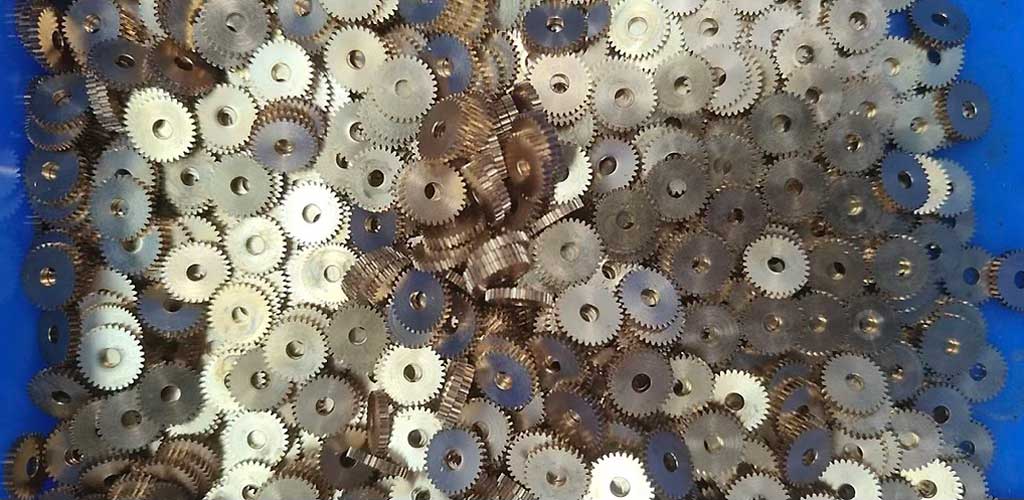
What's more, micro gear hobbers worldwide are under threat by electronics (for example, our indigenous clock makers quickly disappeared when LEDs were invented). Point being, rinse-repeat this concept worldwide! Minor point being, I've sampled gears from China, South Korea, and Japan as I seek a tertiary supplier (backup to the backup), but so far, haven't found one who maintains the tolerance we desire. It's an ongoing search because I'm concerned for the very health of their business.
Nevertheless, gear-wise, beyond designing for the servo, and then selecting from their line card, I do specify materials. An example being, while I could use brass/steel combo gears (brass is a very nice material but one which wears relatively quickly when subject to vibration), we resort instead to stainless steel within ProModeler servos. But there's more.
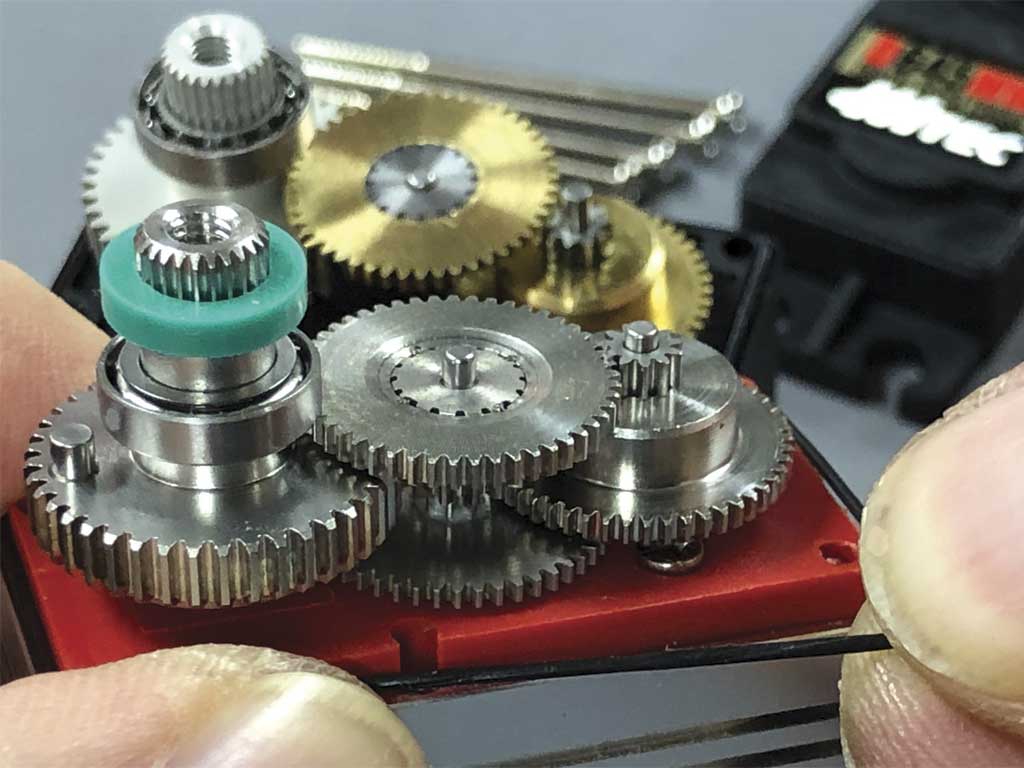
For example, in this photo, two similar performance servos, same price, one by Hitec versus ours. Your money, your decision, but in no universe (in our opinion) is their servo the equal of ours. Proof? Examine details like the green seal seal at the output shaft. It's made of Viton, is a custom mold just for us, and along with a dozen o-rings seals up our servo. This versus nothing seal-wise for their servo. Does it matter? I suppose the answer to this depends on the customer. We think it does else we don't go to the trouble, take my meaning?
But the real point of this photo is to show you brass/steel combos versus stainless/stainless combo gears in ours. Most servos you're going to find on offer will be equipped with metal gears, but which metal matters. Note; there are two case seals (very large o-rings) sealing the case components like the one being pulled away slightly to showcase it. Again, theirs have none. Put another way, when deciding . . . it's your money.
American made
So here's the thing; we're not offering you Made in America because it's a legal definition determined by cost of components and the motors or gears alone mean we can never meet it. However, we 'are' your (America's) national champion as regards servos. And in exactly the same way as Boeing is America's national champion for transport aircraft. Moreover, while they are going up against international competitors like Airbus (Germany), COMAC (China), and Embraer (Brazil), we in turn go up against a plethora of servos producers 100% out of east Asia.
Example of our competitors include amongst many Hitec (South Korea), Futaba (Japan/Philippines/Malaysia), Spektrum (China), MKS (Taiwan), Jeti (China), FrSky (China), Savox (Taiwan), JR (China ), Core (China), Bluebird (China), TowerPro (China), E-Flight (China).
Ditto any of a butt-load of private label servos to be found on Amazon.
Circling back around to Boeing, do they produce aircraft in America? Yes, but . . . same but as us. Literally the same exact 'but' because if we take, by way of example, the world's most popular aircraft (737 we've all flown), components are sourced from 20 countries across 6 continents as you can see in this chart.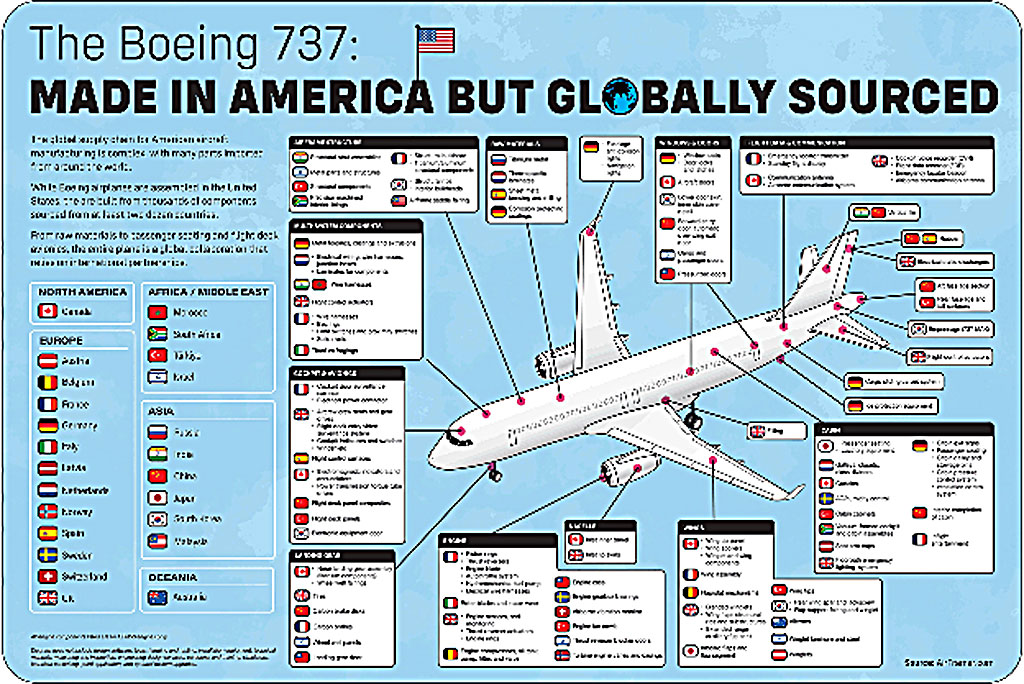
And as you can also see, we're not talking about little things like nuts and bolts. Instead, we're talking about critical systems like engines, which may be CFM (French) or Rolls–Royce (English). Similarly, wings are French, and the entire stab assembly – tail cone, and aft fuselage – are Chinese.
Point being, next time you board a 737, yes be proud it's an American product, and be proud Boeing are our national champion, but bear in mind it's also the whole world's product. And guess what? It's the same-same with our servos!
Brass tacks – politics
Getting to the pointed end of the stick, what with recent political developments, we've abandoned having PCBs fabbed in China. However, the boards are still populated with components like diodes, resistors, and power transistors.
And to be honest, while I could disemble about 'knowing' their provenance, in truth we don't actually have a clue where many of these bits and bobs actually originate. Why not, aren't they marked? Well, yes, they are marked – but – at the bin level because the components themselves are so tiny they aren't. But even if they were 100% marked, they might be lying. Intentionally?
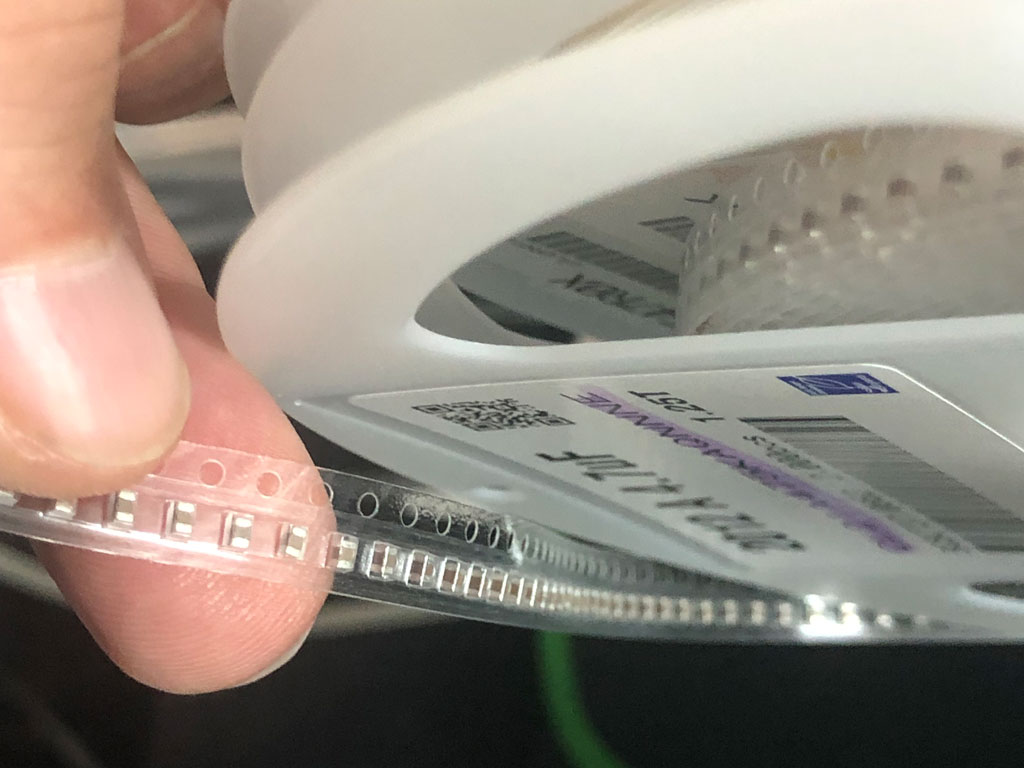
Nope, not to deceive us, but because they buy bits and bobs by the gazillions. So they have bins of tens of thousands of these things (all meeting the same spec, of course). So bins are loaded into hoppers, and then fed in such as way as to be placed on tapes. Then the tapes are rolled up onto reels. This is how we get them, on reels. Thus, only God himself could sort out their provenance.
Point being, whomever produces the roll, labels themselves as the country of origin. So if they do the rolls in Japan, then guess what country is marked on the reel? Yup, Japan. Does it mean the bits and bobs are made in Japan? unlikely. So this is we know. Are you beginning to take my meaning about complexity within the supply chain, and uncertainty regarding component origin?
However, what I do know – for certain – is what with these being very low–tech components, low price dominates and thus, I wouldn't be surprised if they're sourced in low cost producing nations like China, Vietnam, Malaysia, Philippines, and to an extent South Korea versus USA, or Japan. Anyway, te rolls are then subsequently sold to someone else in Japan, China, Taiwan, or South Korea – labeled insofar as country of origin – only to subsequently sold on to our distributors. Folks like Jameco, Mouser, Newark, etc. It's these guys who turn around as sell reels on to us, not the guys making the reels because, once again, we're too small to deal with the bigger players.
What's more, we're at the point for our reels (purchased for prototyping), where we don't even look at country of origin! And not because anybody is hiding anything, but because it doesn't actually matter. These things are like the salt in a recipe. By this meaning an essential component else it doesn't taste right – but – like who actually knows where the salt was mined, finely ground, and subsequently packaged . . . or cares?
Earlier i mentioned tape, so in this next photo here's what I mean. The individual components are mounted to tape rolled onto a reels, and the reels are what we mount on the machine and fed via a sprocket for the pick and place head.
Risk
Note; it's important to know this, modelers buying our servos are buying servos for which, by design we're mitigating more than just supply risk, but also risk against attack. Attack? Yes, because our most important customers require we stay away from producing so called 'smart' servos (meaning ones, which can be programmed externally, or which can otherwise communicate with the outside world, e.g. serial bus servos).
Point being, with the exception of the simplest of UAS (perhaps meant to be destroyed as target practice), they actually often connect servos to devices, which are a lot like a box system used in complex model jets and giant scale aerobatic models. Something functioning a lot of boxes from the likes of AR or Core – where dumb servos are connected for purpose of ganging and/or routing juice (electric current) to them.
Fundamentally, our servos are – 100% – stupid. You cannot connect ours to a programmer and tell it anything. This is referred to not having an attack vector. So all you can do is give it juice (+/- voltage) and send it a PWM signal for control (centered on about 1500ms and extending 500ms in each direction in a range of about 1000ms to 2000ms (how you achieve CM and CCW rotation).
Could we make programmable servos? Well yes, of course. We have the technical know-how but we choose not to because if we did, we eliminate the major reason our major customers come to us for servo. Remember, unlike a modeler flying for fun, the servos are being used for a purpose, a mission. So because they are trying to be proof against electronic attack, if our servos were programmable then it would be kind of self-defeating for us – like shooting ourselves in the foot!
Could we have two lines of products? Again, yes. But the reason we don't is so we can focus on what we do. On the flip side, if you're a modeler, then the fact we don't produce two lines of product, just the one, means you're getting the exact same–same servos as our defense contractors use. Look, not to put to fine a point on it, if you're a modeler reading this and you build ordinary model, we don't necessarily have the servos for you. if, on the other hand you're build special models, then the advantage to you of using ProModeler servos is getting the same servo meeting MIL-STDS as our defense contractors. Does this matter to you? Dunno, it depends. As to who are they? Visit this page, scroll to the bottom and look to see!
Anyway, what buying ProModeler means is getting servos that meet, at a minimum, the below three MIL–STDS. Some meet more, as many as eight. And not to brag, but to our knowledge, we're your only domestic source of this class of servo. Major point being, if your mission depends on better servos, ones protected against shock, vibration, water, and dust intrusion, then call us.
MIL–STD–810G–Part 16
- Shock – Test Method 516.6
- Vibration – Test Method 514.6
- Rain – Test Method 514.5
Anyway, the question first out of a project manager's mouth is usually, 'Do you meet MIL-STDS?' And the answer is yes. Note; servo for a project don't always have to spec MIL-STD, but when they do, then they come to us. Note; it's perhaps worth observing speccing MIL-STD isn't just a matter of reducing professional risk, or even because some UAS costs $25-100k. Instead, and unlike modelers, they require MIL-STDS because there are soldier's lives at risk. E.g. the fundamental purpose behind the creation of the Military Standards is to ensure the product meets the need.
Bottom line? When you plop your butt in an airline seat, whether it's Boeing or Airbus, all the avionics are potted against shock and vibration to meet the same MIL-STDS. They do it for the same reason as we do, there are souls on the line!
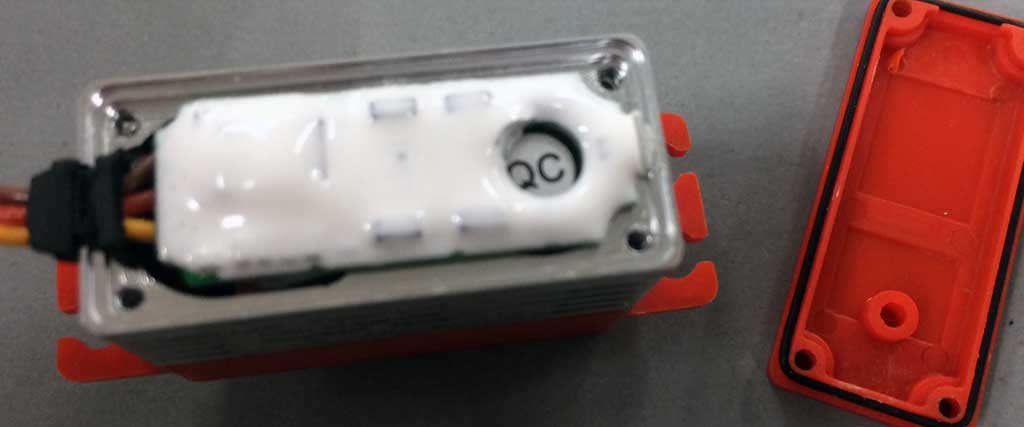
Circling back to our servos being stupid; as regards a basic three wire lead (a plus voltage (+) orange insulator, a minus voltage (–) brown, plus the signal, which has a yellow insulator), the important bit is communication. Communication – such as it is – is only the pulse width instead of digital data. Means the servo isn't subject to being taken over by hackers.
Our specializing in dumb servos means external risk to folks pretty much amounts to zip (not the case with either programmable or serial bus servos, which 'are' subject to attack by bad actors). This is also why you'll never need to update your servos. And note, servos which need to have a BIOS update are coming. For better or worse, some amongst us will believe the marketing hooey about programmable servos, or ones communicating data like voltage and current back to you, is good. Its not because when you're flying, if a servo goes tango uniform you instantly know. You don't also need a voice on the transmitter also screaming at you about servo failure. Duh!
Same as when marketing tells folks cutting edge servo uses magnetic sensors instead of pots (Hall effect sensors). As if this made them better (it doesn't). Learn more, here;
Similarly, gee-whiz features like removable leads periodically make the rounds. Before the product fades away, they scream from the rooftops, look, we're unique. Their big idea being it allows you to exchange an 8" lead for a 30" lead. Fact is all you've done is introduced another point of failure because if you need an extension, those are readily available. We have extensions, so do others.
So if you think about it, could the fact these features are not actually 'better' is why we, Hitec, Futaba, and others don't offer magnetic sensors versus pots. Nor did we go down the rabbit hole of detachable leads? Think about it, it's not that we don't want to innovate (computers have had removable leads on their power supplies for decades). it's that unlike servos, computers aren't subject to shock and vibration because they just sit there on a desk!
Point I'm making is it's always new brands trying to make a splash in the market who come up with ill thought out features like these. Being conservative in approach isn't a fault, it's relying on the tried and true. Basically, instead of studying what's come before (we literally buy Hitec, Futaba, Spektrum, Savox, and MKS servos, even no-names to see what we can learn), they think they're smarter than everybody else. Just remember this when you're outfitting a $2000 model, just because it glitters doesn't make it gold!
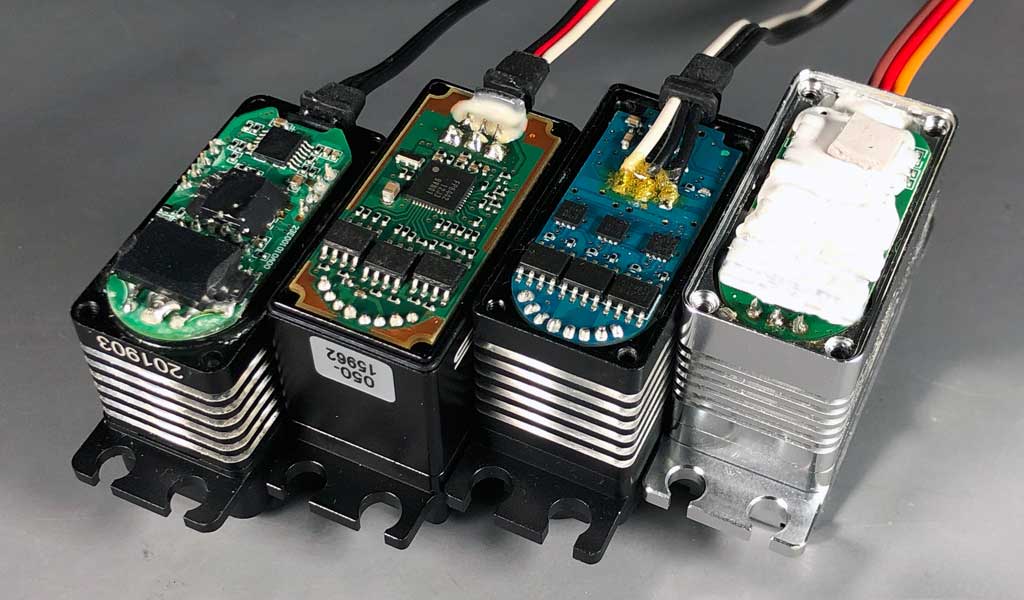
Want to eyeball an example, of what makes something tangibly better? Potting compound does. So in this photo of pricey servos (basically everybody's best, or damn near it), we have lined up Savox SB-2290SG, Futaba HPS-A703, JR S8911BL2K, and our own DS930BLHV . . . all with components exposed to vibration, except one. The white stuff smeared on the PCB is potting compound, or as we refer to it around here, monkey snot because it stinks and sticks like crazy. Once it sets up, even high frequency vibration won't dislodge the component. This makes for a better servo if your application generates vibration. Why doesn't everybody do it? Money. And it's not even the price of the stuff (we buy ours from 3M), it's the added time it takes to apply, set aside to wait, before then assembling the servos. Time is, after all, money, right?
Me? As a kid my dad took me fishing. I always wonder if the bass came to regret striking flashy spinner bait (attractive but totally unlike anything they had seen before). his because after striking the flashy thing they'd never seen they ended up on our dinner table! My point? Be careful of product advertising and internet experts touting the latest fad because how to entice people to part with their coin is the single-most studied topic in the entire world (marketing, aka selling shit).
Saying, don't be marketing-roadkill (to mix my metaphors), or put another way, even when it's gold, it may be 10kt versus 24kt. Eyeball these matchUP articles to see the inside of servos for yourself. To see what the marketing types don't really want to show you.
Nitnoids
These are the bits and bobs some view as inconsequential items. While they may be small they're important. Speaking of things like bearings, o–rings, bolts, lube, etc. In truth we don't always know the provenance of these with certainty, either.
This is because we're buying from reputable sources instead of manufacturers (since we're not buying enough volume to deal with anybody direct – I bet even Hitec doesn't). Bearings, for example, are sometimes marked SKF, which are Swedish, but sometimes they're marked Ningbo, which are Chinese. And sometimes just the box is marked and the individual bearings get just the part number! However, as long as they meet our grade requirements, then we don't really care about branding.
Labor
We no longer assemble ourselves. Instead, we use contract shops. Presently in south Texas. We once did it ourselves but it just got to be too much. We have our hands full milling aluminum (we've expanded to a 3rd machine shop) to undertake everything. Same as with plastic and motors. For example, we own the molds. Easy matter of buying an Absolute Haitian, or Boy injection molding press and molding our own case components.
Problem is, with a press we would make (in just a couple weeks) enough to supply us an entire year! So what do we do with the press (and the operator who is a specialist) the other 50 weeks of the year? After all, the machine takes up floor space, has associated monthly payments, plus and insurance. But the biggie is the labor. Operating these things isn't a job you hire off the street to do, it requires a specialist. That, and a guy who runs a press isn't cross trained to program a CNC mill, do you grok? So this is why we don't mold cases ourselves even though we technically could. Ditto the micro motors in the servos. Could we make them ourselves? Yes, certainly. But ti's the same problem, we could then wind a sufficient quantity in a matter of weeks to meet demand for an entire year! The what do we do with the machine and the operator. So the best course is to buy these, also. Next, let's touch on certification.
Certifications
This refers to big brother . . . the FAA. Dealing with the Feds means red tape, and certification. In addressing certifications, about which we're occasionally asked, our servos are COTS devices (Commercial Off–The Shelf), which means there are no certifications. None. This is on purpose, too.
Basically, if we had to build to FAA-certifications, we'd close the doors, call it a day, and I'd get to go do some flying. Honestly, it's would become too much trouble. And not to put too fine a point on it, but this is why you're only spending a hundred bucks a pop versus a thousand (which they would easily cost if we had to deal with the FAA). Don't believe me?
These are aviation products, ones with pretty much the exact same capabilities, but where some are made for the experimental aircraft market (homebuilders), and the other for the certificated aircraft market like Beechcraft, Cessna, Boeing, Airbus, et al. No, not kidding . . . look at these;
- BendixKing xCruze 100. . . ~$4000
- Garmin GFC 600 . . . ~$58,000
And note, both control pitch, GPS roll steering, plus altitude hold, and both include servos (and these are both from the same vendor), and the Garmin has a big brother, the GFC700, which costs a butt load more money.
So here's where red tape and the FAA come into the picture, even though the xCruze can be installed in a Vans RV-10 (possesed of a big bore engine just like for a Cessna 210), e.g. an aircraft that can tote four souls, through the exact same airspace, at the same 11,000' altitude, and transport them 700nm non-stop to the same place on Earth. But if a Cessna owner wanted to ditch the discrete components of the 50 y/o autopilot to update the aircraft – they wouldn't be allowed to spend $4000, but would instead be forced by FAA regulations to buy a certificated autopilot – $58k vs $4k – despite both being basically interchangeable function components!
Incidentally, it's my opinion this neatly explains why the FAA keeps folks like me (a Bonanza owner) from upgrading to a safer autopilot. since $58k is basically what the whole airplane is worth, making the investment is senseless economically so folks don't make their aircraft safer. Believe it or not, our Federal government slow down domestic spending (thus hurting the GDP of the USA). So not only do we end up at greater risk as pilots because of the FAA and their senseless red tape, but because an aircraft may only be worth $50-60k, then if the alternative is repairing 50 y/o electronics, or spending enough to buy a whole other aircraft, is it really any wonder why pilots (and their passengers) are flying around with reduced safety. Your government at work.
Anyway, and racing to the finish line of an already much too loooong article, the same holds origin–wise for wire leads, machine bolts, and o–rings. Saying we often don't even know where some are actually made. However, when it comes to potting compound and lubrication, this we do know. Both are US products (3M and Superlube, respectively). But do we know whether precursor chemicals are actually domestic or out of China? Sorry, no clue.
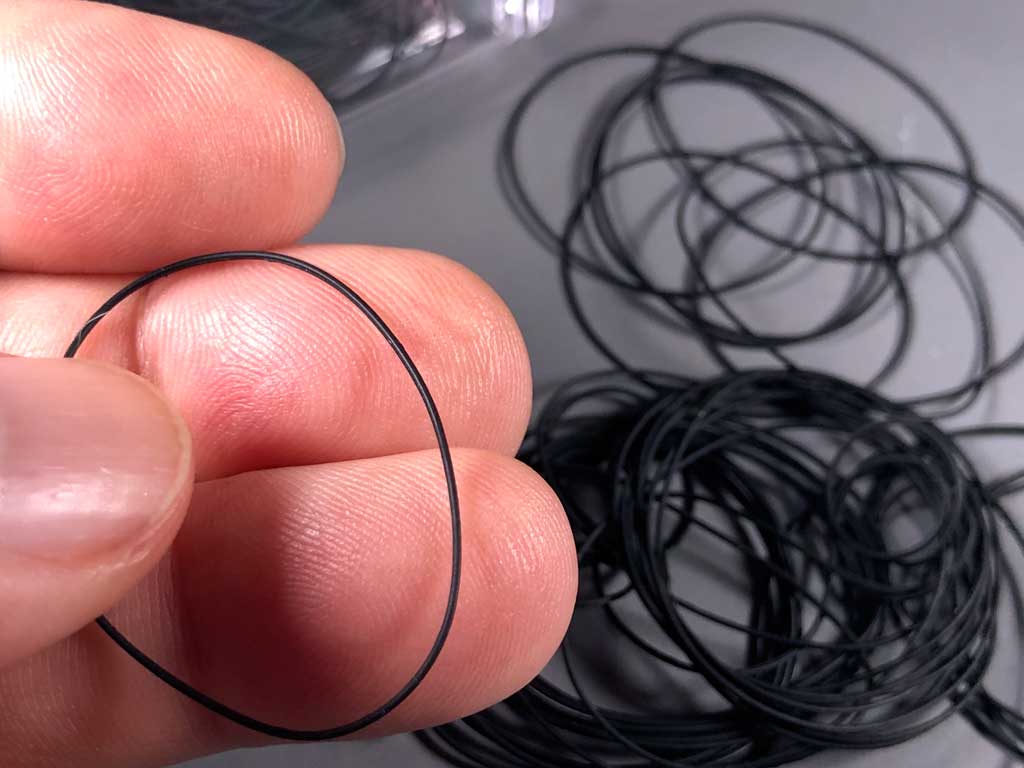
Why not? Simple, it's because – by way of example – say we buy 500 sets of gears to produce a batch of DS180DLHV servos. Yes, we know who hobbed the gears for us, and even what grade steel is used because we specced it. But many components are bought by the keg (by weight, like enough for 100,000 servos). For example, screws or these o–rings.
And now, since we touched on gears, allow me to share a bit of inside baseball. During the COVID crisis, when labor was in short supply and everybody was scrambling to keep the doors open, I got a call from my foreman. He wondered if we'd changed gear suppliers (of course not, I'd never do that without his knowledge and involvement). So I respond, no, and he said, you'd better come see this.
So I drove over to the machine shop and on a pallet of gears, there were some gearsets in different packaging and labels. The printing was different (and not that we speak or read Japanese, Chinese, or Korean, but they look very different). So I took a photo, used Google, and identified the real source of our gears.
So there we were, thinking for years we were buying Japanese gears only to discover they were actually being hobbed in Taiwan! So in turn, I reached out, got their pricing (better because I was eliminating the Japanese middle-man) and said pricing was good enough that for what I had been paying previously for brass/steel compound gears I was able to get stainless . . . and customers benefited because instead of getting greedy, I upgraded our servos to all-stainless gear trains and kept the price the same!
Bottom line
Finally, let's put the hay down where the goats can get it. The neodymium magnets within the motors are Chinese. There is no other source in the world. These super powerful high temperature magnets are the fundamental reason the micro motors used in servos are even able to exist!
Without them, instead of our being able to offer an 1155oz–in standard class servo, we'd top out at maybe 100oz–in – like we did in the 1970s. It's down to fundamental physics. So we need rare earth magnets and this give the Chinese quite a card to play in trade negotiations (as do prescription drugs when negotiating with the Indians because everything in the world is interconnected supply-wise).
What's more, nowadays, entirely because of politics (and we don't do politics, we're engineers) but when asked, we can explain in detail more about the who, what, when, where, and why surrounding component origins than many others. And it's a point of fact, we have precious little ability to affect anything about our input costs. Heck, even mighty Apple is having trouble moving iPhone production out of China to India and has already said flat out, no to moving production stateside! And if they can't move the needle, then what hope do minuscule players like us have?
Note; when I say no other source in the world for the magnets, I mean nobody else on planet Earth makes them. This is why my Japanese suppliers have been having a devil of a time recently obtaining rare–earth magnets. Their PM (Prime Minister) and we're dipping a toe into politics, recently made a statement regarding WWII (the Japanese were the bad guys), and as a consequence, the Chinese (collectively) lost their shit. And predictably, said shit instantly hit the fan of the Japanese supply–chain (meaning our motors). And it's more than that as domestic policy has changed and now there are two prices an international price and an American price.
Anyway, because a politician running their mouth for the benefit of their constituents in Japan, we're now having trouble sourcing motors (affects not just us, but of course, you, too). Me? I dread seeing our next motor invoice. And as if it weren't already difficult enough, now (and also due to politics), folks are asking about the provenance of our servos. Or at least I suspect this is the reason such a subject comes up between folks, who in general, don't care that their electric motors and batteries are made in China. Or who buy a DLE engines for their model versus DA entirely because of price, not politics (the being a more costly domestic product).
Wrap up
Look, I want your business, but my hands are basically tied supply chain–wise. Anybody tells you different, e.g. that good quality South Korean Hitec servos have components only sourced from South Korea is full of shit. Similarly, that our high quality Taiwanese competitor, MKS, doesn't use anything within their servos, which is sourced in China, is also lying through their teeth. I know this because we, too, use stuff out of China. Means you can't buy our servo? Oh well, can't be helped. Especially considering no matter what, everybody's magnets come from China . . . no exception. Me? I bet an awful lot of everybody's nitnoids, do, also because supply chains are complicated!
––
John, always hopeful for more business but simply unwilling to play dumb about the real world.